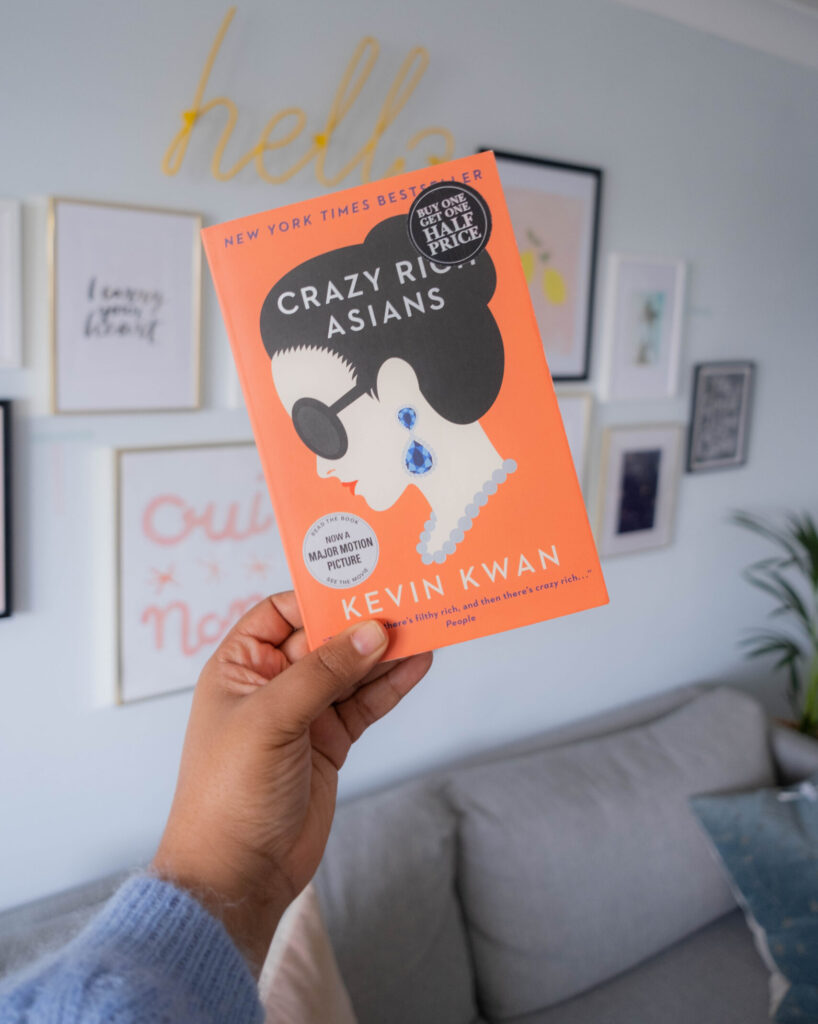
Crazy Rich Asians: The Book
This week, I’m joined by Michelle of the Daisybutter blog to discuss Crazy Rich Asians, the first in a trilogy written by Kevin Kwan!
In Part 1, we chat about THAT LEG SCENE, Get Out, and our mutual love of dumplings among things!
You can find Michelle on Instagram and on Twitter. You can also find her incredible blog, Daisybutter where she writes about books, mindfulness and her experiences being British-born Chinese.
Listen to the episode below!
Full Episode Transcript
Ghenet: Hey, it’s me, Ghenet. We’re back with a new episode of The Book Was Better. But first, I’ve got a little announcement for you. The podcast is now on Patreon. If you’re unfamiliar with Patreon, essentially, what it means is you can become a supporter by pledging money, and that money goes towards helping me run the podcast and keep it going. In return, you get your hands on some pretty fun bonus content, if I do say so myself. Just head over to patreon.com/bookbetterpodcast if you’d like to find out more.
Also, just a quick note about the audio for this and the following episode. I’m still learning on the editing front. So, you might hear some background noise, some bits of feedback, and even on occasion, my cat. My apologies in advance. I’m still working out the kinks. I hope it doesn’t disrupt your listening too much. Now, on to this week’s episode, we are talking about Crazy Rich Asians by Kevin Kwan and his 2018 film adaptation with Michelle of the Daisybutter blog. Happy listening.
[The Book Was Better Podcast theme]
Welcome to a brand-new episode of The Book Was Better. I am joined today by my wonderful pal, Michelle, who I’ve known for many, many years. We are very good friends and she is actually the one who introduced me to the book that we’re going to be talking about today and the film. We went to go see it together. But before we get into that, Michelle, do you want to introduce yourself and say hi?
Michelle: I do. Hi guys. I’m Michelle and I’m very much a Pisces. By day, I’m a digital copywriter and a content person. By night, I make and sell candles and I write my blog, Daisybutter, where I share my everyday life as a British-Chinese woman.
Ghenet: Just so multitalented. We’re going to be talking about Crazy Rich Asians, which you and I went to go see in the cinema together. Do you remember?
Michelle: Yes, for the glamour press screening, wasn’t it?
Ghenet: Yeah, there was some screening. Two people that you knew won tickets, one of them was me, and the both people when we found out, we were like, “Oh, my God, Michelle,” because we knew how much we loved the book. It was me, and you, and your sister, and Amber?
Michelle: Amber, yeah.
Ghenet: Yeah, that was fun.
Michelle: That was such a fun night.
Ghenet: Then, I actually read the book after I’d seen the movie, whereas you had the opposite experience, I guess, didn’t you?
Michelle: Yeah, I’ve read it first. I didn’t realize you read it afterwards. But yeah, I read the book first. So, I did a bit of a speed read before the film came out because it’s been on my list for ages, and then, I thought I’ve got to get it read now before the movie comes out. [laughs]
Ghenet: How funny. Yeah, no, I hadn’t read it until it was something that I’d heard you talk about a lot, and then we went to go see the movie, and I loved the movie, and then I was like, “Oh, I want to read the book.” But I thought I’d give it a bit of distance before I went into the book, and then I read the book, and there were definitely some differences. I still enjoyed the book. In fact, earlier this year, I read the other two books in the series. So, if you don’t know Crazy Rich Asians, it’s actually part of a trilogy by Kevin Kwan. The first one is Crazy Rich Asians. The second one is–
Michelle: China Rich Girlfriend. Yeah.
Ghenet: China Rich Girlfriend, and then the third one is, Rich People Problems. It follows everyone’s stories. But Crazy Rich Asians is the first one, and it’s the only one at this point that’s been made into a film.
Michelle: Yeah, I think so.
Ghenet: Hopefully, the others are coming. We will see.
Michelle: And discuss [crosstalk] [unintelligible [00:03:43].
Ghenet: Yeah, I really have. But yeah, let’s talk about the book. The first thing I wanted to look at actually is the family tree. In the front of the book, they’ve got a breakdown of the Young family, the T’sien family, and the Shang family, and how they’re all interconnected. Then, on one side of the pages, there’s a bunch of footnotes, and they’re just really– it’s like Gossip Girl.
Michelle: [crosstalk] savage. [laughs]
Ghenet: So, savage. I think my favorite one is, “This is what happens when you get a facelift in Argentina,” and I’m just like, “It’s quite funny, though.” Yeah, Crazy Rich Asians follows the story of quite a few people actually. The main characters, I think, are Nick and Rachel, next mom, Eleanor, and then Nick’s cousin, Astrid, as well as his cousin, Eddie, and then you get to see and learn about all of these other people that exist in this world. It starts with a casual bit of racism as it does. So, we open at a hotel in London in the 90s, I think. Nick, and Astrid, and their moms as well as their cousin Eddie have arrived at our hotel and the manager has decided that he doesn’t want them there because they’re Chinese, and the manager’s name, I literally have in my notes, Reginald Ormsby [twat].
Michelle: [laughs] Another scandalous footnote.
Ghenet: That was my own [crosstalk]-
Michelle: Your own.
Ghenet: -how I was feeling, just like the name itself. I was like, “Oh, what a name?” Reginald Ormsby.
Michelle: It kind of had to be for a moment like that. [laughs]
Ghenet: Oh, yeah. It did. It really did. So, he basically won’t led them into the hotel, and then Astrid’s mother, Felicity Leong pulls the ultimate power move, and goes outside, and calls her husband, and her husband buys the hotel. You know, like you do. Then, we fast forward to many, many years in the future. Nick and Rachel are together in New York, and Nick invites Rachel to spend the summer with him in Asia. She’s never been to Asia, and that’s where the story takes off really, isn’t it? This decision to bring Rachel to come meet his whole family.
Ghenet: Yes. Exactly. Which is quite a big deal, actually, I think in any culture, really [crosstalk]
Michelle: I think in any culture, yes, but I think in the Chinese culture even more so, because that is when it’s getting serious. I remember when my partner met my family over in Asia for the first time, and that was a big deal. That’s a good 30, 40 family members to meet over there. [laughs]
Ghenet: I mean, I can also attest “the number of relationships I’ve had” and then the number of them I actually introduced my family is [crosstalk] the man I married.
Michelle: [laughs]
Ghenet: So, I can totally relate to that element of it of like, “Oh, my God, he’s finally bringing a girl home?” Ooh, it’s all very exciting, isn’t it? So, we meet the various family members, the whole world finds out about Rachel and the fact that she’s coming. These families gossip all the time, don’t they? I think that’s one of the things that runs through the book.
Michelle: Yeah. I would say that’s one of the things that I love the most about the film, is how accurate that is because things spread like wildfire. Everyone knows each other. In Asian communities, I think they’re all quite tight knit even if you don’t know them personally, everyone knows each other in some way or another. So, that felt so accurate.
Ghenet: Yeah, it was very just the way that it goes. I love what they do in the movie where you see it very much in real time in a way that you’re just like, “Oh, my goodness.”
Michelle: With all of the WhatsApp messages and stuff. Lovely.
Ghenet: Yeah, with the messages, and then the mother, Eleanor, calls Nick in the movie literally as they’re finishing the conversation that they’re having about her going to visit and you’re just like, “Oh, they weren’t kidding.” [crosstalk]
Michelle: [laughs]
Ghenet: Then, we move on to Eleanor finding out about the situation. I literally wrote in my notes, Bible study aka gossip talk, because rich people apparently really love talking about other people’s money and how they’re spending it. That’s another theme that happens quite a bit. Oh, and then I also wrote in my notes, “Nick really is just throwing Rachel to the wolves.”
Michelle: Oh, God. He really was. He did not set her up for any–
Ghenet: Yeah, he didn’t tell her anything about her family. Even throughout the book, that’s just a very, very regular occurrence. I think one of my favorite interactions is probably– it’s a little bit later in the book. It’s when they go to Nick’s Ah Ma’s and one of the things that I talk about a lot in the book and also in the film is that, this relationship with Nick and his Ah Ma is really strong, and they’re really close, and he’s the favorite, and he actually grew up in her house. He takes Rachel, and Rachel is like, “You grew up in a palace?” Nick is like, “No, no. It’s just a house.” Rachel is just like– I could feel the side-eye through the words, just reading it even in my head, I was like, “Nick, come on, now. Come on now. This is a literal palace.”
This is something that they touch on a lot in the book that isn’t the same way in the movie, is that the young family is incredibly discreet, and people don’t really know them. So, in the movie, the scene when Rachel’s like, “Oh, my boyfriend’s Nick Young,” and then they have this really hilarious reaction where they’re just like, “I’m sorry?”
Michelle: “Pardon?”
Ghenet: “Pardon me?” Someone’s food is falling out their mouth.
Michelle: It was so much more discreet in the books.
Ghenet: Yeah.
Michelle: So, you get the sense that they’re from old money as opposed to being so lavish. In the film, as it was very much– it was quite showy I thought, and that made it look as though Rachel had been completely blindsided by her boyfriend and [unintelligible [00:10:10] of what reality was.
Ghenet: But it’s an interesting thing to look at, because even within the movie, there’s still a very clear difference between the old money and the new money. But in the book, there is this idea that the people with old money know how to be discreet and they are very secretive about it. And the people with new money flaunt it and are a bit ridiculous almost in some way.
Michelle: Yeah, definitely. I think that’s one of those things where it gets translated to the big screen and obviously, it has to be somewhat cinematic. So, in some ways, I think it was a shame that it came across that way because in the books, it was just so nicely done, I feel.
Ghenet: Yeah. No, I know what you mean. It has to translate in a way that the audience can understand, because I found when they were talking about how people were spending their money, there’s that scene, when they go to Araminta’s bachelorette party even, and she’s like, “Look at this plane, and we’ve got this thing on this plane, and there’s a yoga studio, and there’s this thing, and that thing, and that thing,” it was literally so ridiculous that I was like, “This can’t be real. Do people actually spend their money this way?”
Michelle: Yeah, exactly. It was like she was reading out a hotel brochure rather than, “This is what’s happening.”
Ghenet: I think the way that they talked about money in the book, it was a little bit difficult for me to fathom, because it just felt so ridiculous. Whereas I think in the film, obviously, they have to be a point of recognition.
Michelle: Yeah, absolutely.
Ghenet: Or, things like when Astrid comes home and she’s like, “Here’s my shopping. Let’s go hide it everywhere.” In the books, they talk about how she wears a lot of vintage stuff, and she doesn’t really shop in those big boutiques. But literally every single shot of that scene when they’re hiding all of her shopping, it’s like Dior bags and–
Michelle: Yeah. It’s the labels that– [crosstalk]
Ghenet: It’s the labels. But it’s the labels that people inherently associate with luxury and the fact that she walked in with 20 bags gets the point across that she’s absolutely minted.
Michelle: Yeah, I love that scene where they’re tucking them under the guest house, just over the bathroom mirror. [laughs]
Ghenet: Yeah, like you do. Oh, there’s one where she puts it in the kitchen in the tea caddy. She’s like, “Ooh, let me just put this little box of Dior into the tea caddy and then pretend–” Imagine putting your Jimmy Choos behind the dryer. Like, “What?”
Michelle: [crosstalk] in places that apparently her husband would have never looked.
[laughter]
Ghenet: Yeah, we’ve delved now into the difference between books and films. It just happens inherently though, isn’t it? When you’ve read something and you’ve seen something, it’s just always a really interesting conversation. Let me find my place in my notes. I literally have so many pages of notes. A lot of my notes are not necessarily plot driven as much as just general comments. One of the things I did want to talk about too was and this is, I think, relevant for both the film and the movie is they constantly talk about being like “the right kind of Asian being from the right kind of family.”
I just think that’s such an interesting topic, because I don’t think it’s something that is specific to the Asian community, but it’s definitely one that they bring up a lot in these books. It’s a very big theme of being from the “right kind of family.” I’m using air quotes here. Obviously, this is audio medium, so, you can’t see me doing that, but Michelle can see me doing air quotes when I say, the right kind of family.
Michelle: Had to be air quoted.
Ghenet: But yeah, I’m curious about your thoughts or experiences on that because they make the distinction between Rachel being Chinese, but she’s American-born Chinese. Then, I was looking on IMDB about trivia about the movie, and apparently, obviously, while it’s really amazing that this is a predominantly Asian cast film, apparently, there was a lot of conversation about the backgrounds of the actors who are playing it and whether they were “Chinese enough.” So, it’s just such an interesting– that even in the book and the film, even in just making the film.
Michelle: Yeah, even within this universe.
Ghenet: Yeah, it exists within all of this anyway, which I just thought was so, so interesting.
Michelle: I like to dislike that part of this whole Crazy Rich Asians world if that makes sense, because for me, I really appreciated that they talked about Rachel’s as an American-born Chinese being, potentially not the right sort of Asian. As someone who’s British-Chinese, I’ve always thought maybe I’m not quite enough, being someone that grew up in England, born and raised in England, when I go back to Hong Kong and Malaysia where my parents are from, often it feels like I’m not quite the right sort of Chinese person, because I’m inherently so British and many of my mannerisms, even my Chinese accent is a bit of British apparently, which obviously, I can’t hear because I just hear Chinese. So, I really appreciated that they touched on that both in the books and the films. It’s something that no one ever talks about, I feel. I feel we’ve really been underrepresented in all media. I rarely see anyone that looks like me or is in the same position as me. So, I appreciated that.
Definitely, with the negative representation of Asians, how the casting was done. They mentioned a lot of the actors weren’t wholly Chinese, but they were half white for instance, which they didn’t see as a great representation, to which I say there’s not really enough East Asian actors in the industry anyway. So, they had a smaller pool to choose from. So, I think it opened up a lot of conversations around that, and it’s something that is quite a new conversation too, because I think representation, as you can imagine, it’s just been terrible in Hollywood up until recent years.
Ghenet: [laughs] Yeah. No, I do. I do get where you’re coming from with that. There’s a similar conversation when you have black British actors playing Martin Luther King and people who are really big within African-American history and stuff. I understand some of the sentiment but on the other hand, I’m sort of going, “But we’re fighting over scraps. This is not the bigger picture,” I guess or is, I don’t know. It’s a very nuanced discussion certainly.
Michelle: Yeah. There’s a lot to unpack.
Ghenet: But I appreciate that it is something that comes up time and time again. Even as they’re moving through, going back and forth to Hong Kong and in Singapore, and Malaysia, all of this stuff, it comes up again and again and again. Even Nick’s family in the books, they’re very British, which I think is quite funny. Well, maybe not funny, but I think it’s quite interesting. They’ve changed it a bit in the film. In the film, Rachel and Nick go around and they’re all making dumplings. But in the book, his grandma makes scones.
Michelle: Yeah. I love the dumpling scene so much. [giggles]
Ghenet: She gets like– [crosstalk] Oh, yeah, me too.
Michelle: That is literally my family on a Sunday afternoon. I wish I was kidding but it’s literally a production line down in the [crosstalk].
Ghenet: It sounds like so much fun, though.
Michelle: It was fun.
Ghenet: But it’s just such an interesting conversation, isn’t it? Because obviously, we know about the history of the world and colonialism and occupation of these areas that has a knock-on effect. So, even now that they’ve left, all of these people, they still hold that as the–
Michelle: As the as the ideal, I suppose. I’m obviously here because my parents emigrated here on the basis that they had a right to a British passport because their countries were colonized back in the day. I wouldn’t be British-Chinese, I’d probably be just a bog-standard Hong-Konger.
Ghenet: Yeah.
Michelle: I do appreciate, especially in the books more so than the films, about how they nodded to all the Britishisms that the Young family have solely because Eleanor was educated in the UK for x, y, z reasons.
Ghenet: Yeah, there’s a lot of elements of it. There was a lot of things. I had notes about even religion, the fact that these religions, they’re in Bible study and they’re talking about how we’re Methodist and all this stuff. These were things that did not originate– They were brought to them but [crosstalk].
Michelle: Brought to them.
Ghenet: I had to be polite.
[laughter]
Ghenet: We can talk about a book that has a great plot and it’s very fun, it’s very entertaining, but there’s so many elements to it that actually make it. It’s like the meat and the potatoes of it.
Michelle: Yeah, definitely.
Ghenet: I think that is something that I found really interesting just how all of that moves around each other.
Michelle: Yeah, me too. I think one of the things I noted down was, I really appreciated how it’s a modern portrayal of East Asians. I want to say East Asians just because obviously it’s not just Chinese people portrayed. So, I appreciated that they were like, “No Asian accents,” again with my air quotes. No Asian accent, there’s no particular [crosstalk]
Ghenet: They [crosstalk] Mickey ruining the situation.
Michelle: Yeah, exactly.
Ghenet: [laughs]
Michelle: I put there’s no particular Asian setting. So, obviously, yes, they’re in Singapore. They’re in Hong Kong, Malaysia, all these wonderful countries, but it’s not particularly like, “This is Chinatown and these are really Chinese or Asian-looking things.”
Ghenet: Yeah, that you recognize as Chinese are Asian-looking things. These people existing in this world.
Michelle: This is just people existing in the world. Yeah, I really appreciated that. There’s all these little nods to like just how modern East Asians live. They live in a world just like any other person in the West, which obviously, that is the mainstream narrative that you would see in Hollywood.
Ghenet: You actually lived in Hong Kong for a couple of years, didn’t you?
Michelle: Yes, I did. I used to work and live there for two years in my mid-20s.
Ghenet: What was that like? Did it feel like– obviously, because you grew up in the UK and also please, by all means, tell me if this an inappropriate question, or if I phrase it badly. But going from a culture where you are British and then going for a culture where it’s more of your Asian heritage that’s highlighted there, what was that experience for you?
Michelle: It was definitely– I say this as someone that regularly went between England, Hong Kong, and Malaysia as a kid. I used to go back every year to see family, because that’s where my parents are from, my mom and dad are from. Even with all of that, behind me at the age of 24, going there, it was definitely a reckoning on my identity, I found. Here in England, I’ve always felt that I’m not enough, people will always treat me as the other because not only am I not white, but I’m not also euro centric looking. I’m obviously not from here as such. I’ve always felt maybe if I ever got the chance to move back, I’d move to Hong Kong and then try life there. Maybe I would feel like I fit in but people can see you coming a mile away. They know you’re not [crosstalk] I’ve got apparently British manners. So, I had no idea I had.
Ghenet: You stick your pinky out when you drink your tea. It’s that what that it is? [crosstalk]
Michelle: No, apparently, [crosstalk] really polite.
Ghenet: Oh [laughs]
Michelle: I didn’t have enough of the Hong Kong slang, which I quickly picked up. But it’s really interesting to think that, yeah, the different experiences, I think. But I definitely felt– I obviously got more used to it. I will say assimilated really quickly when I was in Hong Kong more so than when I moved back to England a couple of years ago, and I found it really difficult to get back to the UK way of life. [laughs]
Ghenet: Oh, interesting. But also, then we have this family who is inherently incredibly British.
Michelle: Yeah. They’re very British [crosstalk].
Ghenet: They’re very, very British. I wrote down in my notes, because they go to visit Ah Ma, and Rachel’s like, “Who are these ladies with her?” Nick’s like, “Oh, those are her ladies’ maids.” I literally wrote down in my notes, “Ladies’ maids? What is this, Downton Abbey?” Was like–
Michelle: Full on like– [giggles]
Ghenet: That’s literally what is. She has ladies’ maids and she makes scones. But that’s fine. So, I want to talk for a second about the bachelorette and bachelor party, [crosstalk] because I think of all of the things that are a display of wealth, those two things stick in my mind as such huge– They’re very key moments, especially with the bachelorette party where you can see Rachel is just so outside of her comfort zone as someone who doesn’t have a lot of money and, yeah, and Colin’s entire reaction to his bachelor party, it’s a whole thing.
Michelle: [laughs]
Ghenet: Bernard Tai is also a character [crosstalk] that I do not like.
Michelle: [crosstalk] I would leave it at that. [giggles]
Ghenet: Yeah, in his first entrance into the book, he very casually uses that word [crosstalk]
Michelle: Yeah, I know.
Ghenet: -Cool, I know everything I need to know about you, okay. He also says some things that are quite racist later on as well. In fact, I wrote in my notes in big capital letters, “Bernard, you are trash and racist.” Trash and racist are both underlined. But that’s why– [crosstalk]
Michelle: Yeah, but what isn’t he, he’s racist, he’s sexist, his shares like an awful character. I think in some ways, it was important for Kevin Kwan to have written him in both obviously book and film to show you that there’s all different types of people, no matter where you’re from. Because that thing highlights how even as, I hate this phrase minority ethnics, obviously East Asians, there’s anti-blackness sentiment, there’s all sorts of xenophobic sentiments. I think it opens up that conversation really well, because, again, that’s something that you don’t hear about, and it’s a huge problem. So, in that small way with that awful character, Bernard, I think it’s good to open up those conversations.
Ghenet: Yeah, it is. I think also, there’s a moment where they mention a quite a bit the darkness of people’s skin, that’s something that comes up quite a bit as well. So, there’s a lot of nuance. I know, obviously, they don’t specifically mean black, but the concept of all of these things, how they’re tied in together, talking about being from the right family, but then also these other things like physically how people look, whether or not they’ve got the eyes, whether or not they have a darker complexion, whether or not they have a more fair skin, all kinds of layers on top of each other. Certainly, that moment when he says that is really uncomfortable but then, also when he makes a slight very racist comment later on in the book. It is very specifically to someone who is– he’s not Chinese or East Asian. I don’t think. I think he’s–
Michelle: Yeah, I think he might have been South Asian.
Ghenet: Yeah.
Michelle: I can’t quite remember. Obviously, it’s an awful thing to have happened. But I do enjoy how even in the– obviously, in the film as well, in some ways, I feel they were problematic in the casting. It was all non-Chinese or South Asians that were portrayed in lower ranking roles. So, things like housekeepers, the doorman, and stuff, that’s again linking into the conversation we had earlier about being the right sort of Asian, and how different parts of the communities like the wider Asian community pit themselves against each other.
Ghenet: Oh, absolutely.
Michelle: I think where I have been to Malaysia quite a lot in my life where it’s very multicultural, you kind of see it. You do see it in that communities stick to themselves, like different communities living not apart from each other as such, but existing separately.
Ghenet: I guess, it is– I personally, I’m not Asian, I’m not part of that community. So, there’s a lot of nuances there that I wouldn’t have necessarily picked up on. But it is interesting certainly to have a discussion about it, and I guess I can see in that same situation of, it seems most of the films where you have a black actor, they’re usually playing a slave or they’re playing Martin Luther King. So, it’s a similar is– it’s like those are the only two spectrums in which our story can be told-
Michelle: Yeah.
Ghenet: -apparently, according to Hollywood.
Michelle: Yeah, exactly.
Ghenet: Yeah. But the whole bachelor party, bachelorette party, the wedding itself, the way that they talk about what’s happening at the wedding, I think, certainly is the biggest show of money. I think those were especially those moments where I was like, “Is this real? People really do this?”
Michelle: Wild. The bachelorette party, which was crazy to me, genuinely madness like the shopping, it’s just like, “Is this a bachelorette party or is this sort of a different world?” [laughs] In the film, they definitely tried to make it even more outlandish than what you could imagine a wild bachelorette party to be. It literally just went above and beyond.
Ghenet: Where they were on that island, I was like, “Oh, my God, that must have cost so much money.” It must be so expensive.
Michelle: It is almost like cartoonish, I think, in the way that they [crosstalk]
Ghenet: Yeah, but it seems like that a little bit in the book.
Michelle: Do you think?
Ghenet: It feels like that a little bit in the book.
Michelle: I read the book version to be like, “Oh, that’s quite crazy. It’s a really lavish bachelorette party.”
Ghenet: Yeah.
Michelle: I think seeing it visually, I was like, “Oh my gosh, this is nothing I’ve ever seen or will see in my whole life.” [laughs]
Ghenet: Yeah, I will never experience that ever in my life.
Michelle: Definitely not.
Ghenet: Yeah. So, it’s this part when Araminta is giving all the girls a tour of the plane and she’s like, “Here’s the library/media room. Don’t you love how cozy it is? Now, let me show you my favorite space on the plane, the yoga studio.” Yeah, it’s insane. She keeps going about all of the different things, all of the different rooms that they’ve got–
Ghenet and Michelle: On this plane.
Ghenet: On an airplane? Do people do that? Is that real? What?
Michelle: When I think of a plane, I’m sat there, strapped into my seat that I don’t quite fit in. I’m praying for the whole ordeal to be over. I’m not coming out of my seat, I’m not doing yoga.
Ghenet: Imagine doing yoga in airplane in air.
Michelle: My gosh. [crosstalk] Dude, I can barely walk to the bathroom. [laughs]
Ghenet: Yeah. Then, we have the bachelor party, where it’s just a bit ridiculous. There’s dogfighting and gambling. I did love this moment in the movie, obviously, they can’t really do all of that in the movie, but when they’re on the helicopter as they’re pulling up to their boat in “international waters,” Bernard says this thing where he’s like, “Dogfighting, drugs, hookers, that’s child’s play,” or whatever.” But that’s what they did in the book and I was like, [crosstalk] clever.
Michelle: [laughs]
Ghenet: So, they are doing all this stuff, and then they end up on a yacht. Then, Nick, and Colin, and Alistair plan this escape, because Colin is having the worst time, and they just call up a friend who has a helicopter, and they rescue him, and they just go off, go to Australia.
Michelle: Casual.
Ghenet: Like you do.
Michelle: Casually.
Ghenet: I wrote in my notes, “The world is literally your oyster when you have fuck tons of money,” because-
Michelle: Just imagine.
Ghenet: -the fact that it did–
Michelle: Escaping your lavish bachelors party by going on another lavish trip over to some private island. [laughs]
Ghenet: Right. Somewhere else, that you can just call someone and be like, “Hey, can I have a helicopter?”
Ghenet and Michelle: Yeah, sure.
Ghenet: Cool. “Should we just go to Australia?” Yeah, yeah, that’s fine. In a matter of minutes, literally. [crosstalk] happened.
Michelle: Oh, it’s wild. I can just imagine being out there on– not a yacht. Maybe like a little rubber dinghy trying to get a signal.
Ghenet: Oh, my God. I know.
Michelle: No one is rescuing me on my rubber dinghy because I’ve got no signal. My phone, that is all I have. [laughs]
Ghenet: Yeah. Thankfully, for especially the bachelorette party, there was no Willy Straws or [unintelligible 00:31:43] in sight. So, at least, when you have a bit more money, I guess that stuff goes out the window. [laughs] And it’s wedding time. Now, the sequence of events that happens in the book is a bit different to the film. Obviously, due to it being a film, having to have a shorter timeline, all of this stuff gets a bit mixed around. So, the thing with the fish still happens in the book, but she doesn’t tell Nick about it until after the wedding, does she?
Michelle: Yeah, it’s not until after.
Ghenet: Yeah, so the wedding happens and more things happen at the wedding. In the film, obviously, they’ve condensed it and composited some of these characters who are actively trying to hurt Rachel into Amanda Ling, who she sees at the bachelorette party, and all comes together. But in the book, there’s a lot more moments where more and more people are just saying things to Rachel, and revealing Nick’s secret life for whatever.
Michelle: Secret life.
Ghenet: That’s the best way to explain it. Secret life. She’s just like, “Who is this man?”
Michelle: I quite like the timeline of the book became it was a bit more of a slow burner, when you do slowly peel back and unravel some of Nick Young’s character outside of Rachel and outside of this just standard– Yeah, I really liked the way they did it in the book. I’m all for character development, and I love seeing all the little bits, which I don’t think you necessarily get in the films as– [crosstalk]
Ghenet: No, you do have to have a bit of a condensed version for a film.
Michelle: Yeah, just pace being a thing, I think.
Ghenet: But the pace of the wedding, it’s from multiple people’s perspectives as well. So, it’s not just the standard POV chapters that we’ve been getting before. But that’s when everything really comes together, and all of these things are happening at the exact same moment. There’s so many hijinks in this wedding. It’s like a demented game of chess and it’s just like– It is. It’s a demented game of chess, because you’ve got Eleanor plotting over here. You’ve got Astrid dealing with her own stuff. You’ve got just all these people plotting to get under Rachel’s skin, and it’s a lot. Then, I think immediately under this note I wrote, “The way these people spend money feels too ridiculous to be real,” because of the whole wedding sequence. They have like five different weddings in one, don’t they? [crosstalk]
Michelle: The wedding was crazy. I know what Asian weddings are like that. Chinese weddings are pretty lavish. Your whole life has been building up to it but it’s not quite as crazy as that. You could get the Chinese ceremony and reception. Then, you’d have the white wedding experience but also one in the film, it was crazy. I cried, I think, because it was just so well done.
Ghenet: Yeah. Oh, I did, too.
Michelle: Like the bit where her leg comes out.
Ghenet: Yep.
Michelle: Wasn’t that– [laughs]
Ghenet: It’s something else.
Michelle: I remember sitting there watching the film, and I was crying, and then suddenly the leg thing happened, and I was like, “Okay, I cannot laugh now.” [laughs]
Ghenet: We looked at each other, we were both crying. It’s because it’s that moment because they do it really well because it seems really ridiculous that they’ve turned this [crosstalk] into a paddy field. But then she’s playing this really romantic song, and it’s acoustic, and her voice is really lovely, and then it slows down, and then the lights dim, and then the music goes away, and it just her voice, and then it’s like a bit slo-mo, but then you see her light come out, and it’s a little bit ridiculous. You’re just like, “What?”
Michelle: Because I think up until the leg moment, which is now a moment of its own, leg. The cover of Can’t Help Falling in Love, that was absolutely magical. I think that helped to set– it helped tone everything down slightly as crazy as everything did look, and it just became really beautiful, like just a romantic wedding moment. I really liked how they managed to, even despite all of the actual gold leaf just everywhere, all the fresh flowers, the fresh trees, and–
Ghenet: The aisle becoming a little river.
Michelle: Yes, the little stream.
Ghenet: But even doing that in slow motion to just see the water like– [crosstalk]
Michelle: Even that whole [unintelligible [00:36:01] absolutely outrageous. I was like, “Yeah, no, I could deal with this, because I know how rich these people are.”
Ghenet: [laughs]
Michelle: It was the leg that really changed it for me. [laughs]
Ghenet: [crosstalk] It was like, “What?” But then, once they start walking down the aisle, it’s actually really lovely. Then, there’s that really great moment where she’s walking down and everyone’s standing behind her, and they’ve all got the branches with the lights on them, and you see Colin’s face and he’s like, “Ah.” Then, you see her face and you can tell she’s feeling really overwhelmed, and she’s just like, “Ah.” Weddings scenes are always really emotional in movies but this one especially [crosstalk] spectacular.
Michelle: I think also like, [crosstalk] craziness about everything you just listed about.
Ghenet: Yeah.
Michelle: It was nice to see-
Ghenet: Yeah. [laughs]
Michelle: -those human interactions. All of the actors did it so well, because it really captured it for me, I think. And also, I’ve got in my notes, Gemma Chan as Astrid in that scene where she’s clearly heartbroken about this whole thing that’s happened with her marriage–
Ghenet: Yes.
Michelle: Absolutely perfect.
Ghenet: Yeah, Gemma Chan’s phenomenal. I have so many feelings-
Michelle: Me, too.
Ghenet: [crosstalk] Let’s talk about her storyline just for a second, because it is very, very different in the book and in the film. In the book, we love Astrid. She is good people. She is such a lovely human. She also has a really great moment at early on in the book where she talks about– she’s at this party or something, and there are these people that she knows all the time, and this really posh woman is speaking to one of the people, and she’s really dismissive of her until she finds out she’s absolutely minted, and then she comes over and starts being like, “Oh, my God, I’ve always wanted to go to Malaysia,” and Astrid’s having none of it. She’s just like, “Ugh, whatever. [crosstalk] this again. This whole thing again,” which is another really interesting thing, I think, that you don’t really talk about a lot. But it was really interesting to see it portrayed even in a moment where when you are the only non-white person in the room, and I don’t know if you’ve experienced this, but I’ve definitely experienced this, that you sort of become a mascot for literally anyone else who may look like you basically. And that’s essentially this moment, is this woman comes in and Astrid is just being really nice, but she’s really dismissive, and she just is being a bit racist. Then she’s like, “Oh, this person’s rich. Oh, right.” So, then whatever Astrid does is going to be then a reflection on any other Asian person that woman meets for the rest of her life. So, she’s knows that, you can feel that because she really nice to this woman. Not really nice and I think she’s like, “Okay,” and then she’s like, “And time to go.”
But there’s definitely that element, and then she talks about that a little bit. I think that’s a part of Astrid that we don’t really get in the films that she obviously just has a lot of pressure on her from her family, and then also just the circles that she moves in. It’s just a really interesting conversation about that one little thing that may not seem quite a big deal, but it happens all the time when you’re moving in spaces that are predominantly white that you sort of then become this mascot.
Michelle: I think that too. I think, like you said, I would say, I have experienced that when you’re the only nonwhite person in the room, you become– in many ways, you’re othered. You are singled out as token Chinese person. Also, in many ways, you also become part of the furniture. You also don’t exist to them until there’s something crazy. So, in Astrid’s case, the fact that she’s really rich, that suddenly becomes something that, “Oh, this person can jump on her.” This is a defining factor and it does pave the way for anyone else that she might meet who’s like that person. I always feel a bit pressure. I feel like I have to be a good example.
Ghenet: Yeah, I feel like that too.
Michelle: [crosstalk] Chinese person, [unintelligible [00:40:17] they don’t like me, they’re never going to like anyone else like me.
Ghenet: Yes. Oh, my God. Yes.
Michelle: You become an ambassador even though all you want to do is be a person.
Ghenet: Yes, you’re like, I just wanted to– Okay. Oh, this is where we’re going? All right, cool. It makes me think of, did you ever see that film, Get Out?
Michelle: No, because I’m scared of horror films. It is horror, isn’t it?
Ghenet: Technically, but I would say, it’s more of a psychological thriller than a horror per se.
Michelle: Oh, would you say, okay, because if anything’s labeled horror, [unintelligible [00:40:50]
Ghenet: Yeah. I don’t do well with horror films, especially things that are gory. Anyway, this is more psychological thriller, I would say, there’s not really too much like gore. But there’s this scene where he goes to his girlfriend’s family for the weekend or whatever. Obviously, they’re all white, he’s black. So, they have friends around, and like all of he’s the only black one there. He meets this couple, and they’re like, “Oh, hi, nice to meet you. We voted for Obama,” or they said something like that. He goes like, What? Hm.” But when this moment happened, I cackled, Michelle, I cackled because I was like, “Oh, my God. I’ve to leave this party.” I’ve had [crosstalk] situation where someone’s been like–
Michelle: This is when for me in moments like that, the sirens start flashing in my head. I’m like, “I don’t know if this is a safe situation to be in, because it’s not right.”
[laughter]
Ghenet: Yeah, you’re just like– This is when you smile and nod and go, “Excuse me,” and then you just–
Michelle: “Yeah. I just need to get a drink.” [laughs]
Ghenet: Yeah, “I’m just going to– okay.” But that’s literally what it is, is you become sort of this ambassador, and then people feel they want to find this thing to connect with you about, but it has to be something that’s based on your race.
Michelle: Yeah, exactly.
Ghenet: So, when this this moment happened in the book, I was like, “Oh, my God, I’ve been there.” I felt all those things that Astrid was feeling. I feel that’s not a thing that you see very much in books or in films even. It’s just very– When you see it, it’s like that moment of definition.
Michelle: It’s tiny, little– it is a very fleeting moment. But many people who are second-generation immigrants like myself, because obviously my parents are immigrants, is the kind of thing that just really speaks to you. Because they’re tiny moments that you’ve experienced in your life, it happened for about two minutes. 10 years later, that’s still ingrained in the back of my mind, that time it happened to me and I’m like, “Why did that happen? Why do I feel this way? Why has it affected the way–?” I’ll go to a party, be the only Chinese person, and again, I’ll sit there and be like, “All right, well, I have to make a good impression, because I didn’t make good enough of one that other time.” [giggles]
Ghenet: Yeah. You have to just be very– I think particularly with Astrid, she is definitely a people pleaser. She gets that pressure from her family. But we were talking about the Astrid’s plot in the book is very different in that Michael, she sees the text message on his phone, and then she’s very paranoid. But even then, she’s still like, “Oh, God. My parents are going to be so disappointed.” She’s thinking about how other people are going to feel about it. She just doesn’t want to disappoint anyone. Then, she finds out– she teams up with her ex-boyfriend, ex-fiancé, Charlie Wu, who makes an appearance in the post credits in the film and that’s it.
Michelle: We’re still waiting for the second film. [laughs]
Ghenet: Just so we can have more of that please, because the bedroom eyes they were making [crosstalk] in that five seconds was phenomenal. But in the book, she recruits him and they find Michael who’s moved out, because she confronts him about the affair, and he’s like deuces, just pretty much what happens in the film, but there’s much more to the story, and that he actually lies about the affair, like there is no affair. He just wanted out of the marriage.
Michelle: I really wish Astrid had a bigger part in Crazy Rich Asians, the film, because like you said, her storyline is amazing in the book. For me, I felt it dealt with the concept of– I think I’ve talked about this online before, the concept of face. That losing face, saving face, it’s a big thing in Chinese culture where you present yourself in a certain way– I suppose it comes back to the whole ambassador role that we seem to play, but it’s always present yourself in a good light, because you’re affecting the way your family’s portrayed in the community and protecting the way you come across in public.
In Astrid’s case, yes, she is a people pleaser for that reason. So, she does all the charity work, and she was trying to make sure her husband doesn’t feel less of a man, which is a whole other conversation about toxic masculinity. Because he clearly does not feel enough of a man because his wife, Astrid, is super rich and she does all the things. She’s so loved and he’s effectively what he sees as a failed businessman. So, I really liked how Astrid’s storyline came across in that.
Ghenet: Yeah, I do too. I vastly disapprove of the way that Michael felt the need to go about it.
Michelle: Yeah. Oh, totally.
Ghenet: Yeah. He pretends to have an affair so that she will divorce him. But when that moment happens, the fact that she’s like, “I know you’re having an affair,” and he straightaway like, “I’ll go.” He was ready. I’m surprised he didn’t already have his bags packed. He was waiting for that moment.
Michelle: He wanted a way out that wasn’t dramatic, his fault/her fault vibe, and he still wanted to be in control of the situation.
Ghenet: Yeah. Instead of, I don’t know, just having a conversation with her. Imagine if they just sat down and been like, “Look, babe. I’m struggling with this. I feel a little bit your family doesn’t take me seriously. They’re always asking me for tech support and that’s not what I do. Can you just have my back a little bit?” Would that not have been a productive conversation?
Michelle: Exactly. But obviously, he doesn’t feel that he could have that conversation because he just wanted to be seen as the man which– That’s a whole thing in itself. But I think the way Astrid storyline ended up being in the films compared to the book, for me, she was one of my favorite parts of the books. I loved her so much.
[music]
Ghenet: Oh, hey, me again. Part 2 of my conversation with Michelle will be released in two weeks’ time but I hope you’ve enjoyed it so far. If you have a moment, please make sure you rate the podcast, and leave a review as it helps more people find us. And don’t forget to tell your friends. The Book Was Better is hosted, edited, and produced by me, Ghenet. You can find us on Instagram @bookbetterpodcast, and on Twitter @bookbetterpod. Until next time.




Leave a Reply